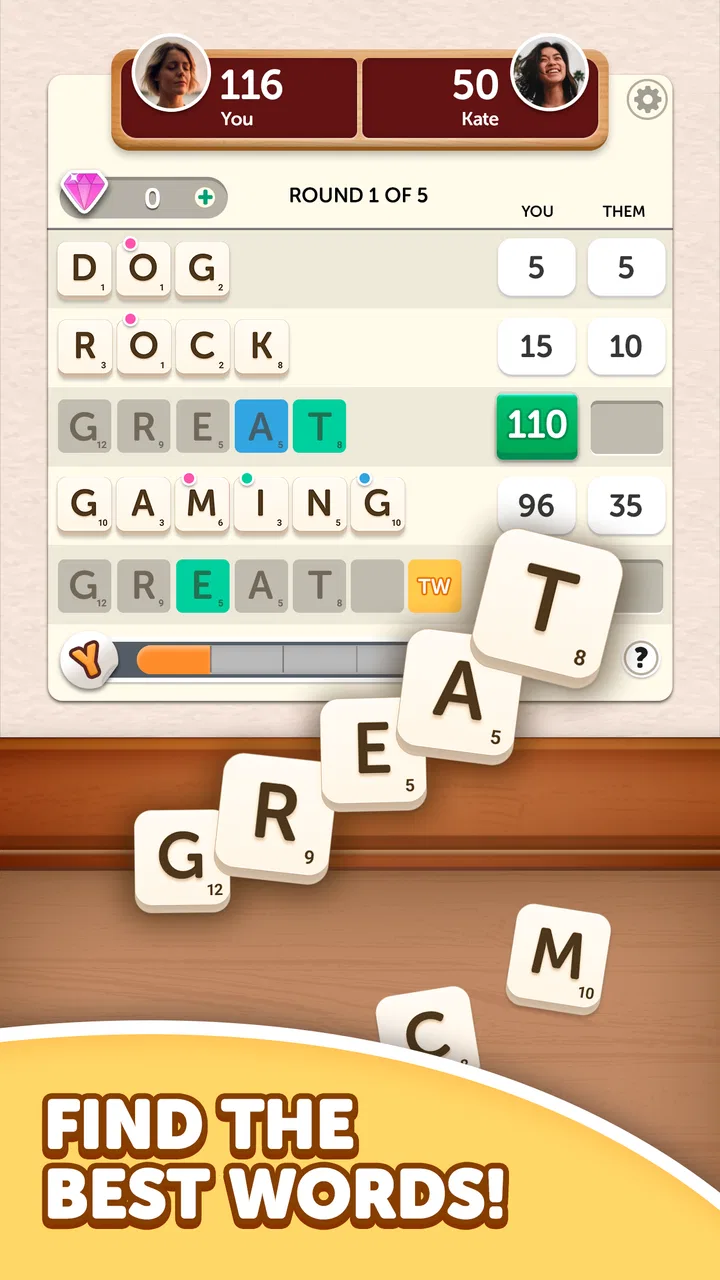
Word Yatzy - Fun Word Puzzler
- 4.9
- Rating
- 1.00M
- Installs
- Free
- Price

 Analysis by App-foxy
I approached Word Yatzy - Fun Word Puzzler expecting a light word game, but its appeal is more specific than that. It combines word-making with the familiar tension of a dice-style score chase, then frames the experience around playing with friends. That mix gives it a different rhythm from a standard crossword, an anagram trainer, or a traditional board-game adaptation.
In my experience, the best way to enjoy it is to treat each round as a small social challenge rather than as a serious language exam. You are looking for useful words, weighing immediate points against better future options, and trying to stay one step ahead of another player. It is easy to understand, but the decisions become more interesting once you stop grabbing the first acceptable word and start thinking about how the scoring possibilities interact.
The game comes from FunCraft Games and sits in the word puzzle category. It is free to start, rated for Everyone, and available for devices running Android 7.0 or later. Its broad accessibility is important because this is the kind of title that works well as a quick shared activity: something I can open while waiting, play during a relaxed evening, or recommend to someone who wants competition without learning a complicated rulebook.
You May Also Like

 Blood Strike: 2.5 Anniversary
Blood Strike’s Loadouts Turn Every Drop Into a Tactical Gamble
A close look at Blood Strike’s custom loadouts: how fast access to signature weapons reshapes its battle royale rhythm, rewards preparation, and narrows the gap between fights.

 Pandora - Music & Podcasts
Pandora’s Music Is Easy to Start, but Harder to Recover
Pandora’s strength is its low-effort path from a seed to a station. Its weak spot is how much confidence it asks you to place in connection, setup, and quiet recovery.

 8 Ball Pool
 Is Built on Rivalries, Rematches, and Routine
A close look at the rivalries, rematches, shared routines, and unanswered safety questions that turn a quick pool match into a persistent mobile community.

 Samsung Music
’s Quiet Strength Is Playing What You Already Own
Its reach comes less from spectacle than from dependable access to a personal library. That simplicity is both the app’s strongest retention engine and its ceiling.

 AccuWeather: Weather Radar
AccuWeather Review: A Quick, Clear Forecast for Everyday Decisions
For everyday plans, the best forecast is the one you can understand quickly. AccuWeather makes rain timing, radar, and local conditions easy to act on, with a few trade-offs.

 Hill Climb Racing
Why Hill Climb Racing Still Turns Crashes Into One More Run
A tiny car, a bumpy hill and one more upgrade: Hill Climb Racing keeps resurfacing because its simple chaos makes every near-miss feel personal.
More From Our News Desk



How the free experience translates into value
The clearest cost advantage is that I can download and begin playing without paying an upfront price. That makes the initial decision straightforward: there is no purchase barrier before I know whether the word-and-dice format suits me. The game includes optional in-app purchases ranging from $0.99 to $49.99 per item, so the free entry point and the possible spending are separate questions. I would start with the free experience and only consider a purchase after deciding whether I genuinely return to it.
That distinction matters for a casual game. A free download can be valuable even if I only use it for short sessions, because the commitment is low. On the other hand, a player who dislikes optional purchases in free-to-play games should look carefully at the purchase prompts and decide on a personal limit before getting invested. I would not describe the existence of those purchases as a reason to avoid the game automatically, but I also would not assume that every part of the long-term experience has the same value without trying it first.
The store information identifies the game as having a 4.9 average from around 95 thousand ratings, with more than a million installs. Those figures suggest that the format has found a substantial audience, but popularity does not remove the need to test the specific style of play. Word games can be very personal: some players want a calm solo puzzle, while others want the pressure of comparing results with friends. This one is aimed more naturally at the second group.
Its current version is 1.19.24458, and the game was released on March 10, 2023. I mention the version because it is useful when checking whether a device is compatible or when troubleshooting an unusual behavior after installation. I would keep the app updated through the normal store process, especially for a game built around ongoing play and social interaction, but I would not treat the version number alone as a guarantee of a particular feature or experience.
What I actually get from a session
The main value comes from the compact decision loop. I am not committing to a long campaign, managing a large collection, or studying a complex set of rules. Instead, I am repeatedly asking which word is worth using now and which move gives me a better chance of building a strong score. That makes the game easy to fit into a busy day, while the competitive element gives short sessions a reason to continue.
A realistic use case is a quiet break with a friend who lives elsewhere. Rather than sending another message that receives a quick reaction and ends there, we can use a round as an ongoing conversation starter. A clever word, a surprising score, or a risky choice creates something to discuss. The game is especially suitable for people who enjoy friendly rivalry but do not want the intensity of a fast action game.
I also see value for families with mixed gaming experience. The Everyone rating makes it broadly approachable, and the basic idea is easier to explain than the rules of many strategy games. Still, “easy to begin” should not be confused with “equally easy for everyone.” A person with a larger vocabulary may have an advantage, and players who are less comfortable with word games may need time to find their preferred approach.
One useful habit is to avoid treating every turn as a hunt for the longest word. A shorter option can be more practical if it fits the available scoring opportunity or prevents me from wasting a better possibility too early. I found that this mindset makes the game feel less like random vocabulary recall and more like resource management. The letters matter, but timing matters too.
Another worthwhile approach is to notice how I react under pressure. When I play quickly, I tend to choose the first word I recognize. When I pause, I often see an alternative that is safer or more valuable. That makes the game a good little exercise in slowing down without becoming a formal learning tool. I would not install it specifically as a language course, but players who enjoy experimenting with words can get an incidental vocabulary benefit from repeated play.
Where it differs from familiar word-game alternatives
Compared with a crossword, this is less about following clues toward one correct grid and more about making tactical choices with the words available to me. A crossword is usually a solitary solving exercise, while this game’s strongest identity is competitive and social. If I enjoy deduction, themes, and a quiet puzzle board, a crossword app may be a better match.
Compared with a pure anagram game, the Yatzy-inspired structure adds another layer of decision-making. I am not only asking whether I can form a word; I am also thinking about how that word contributes to the round and whether a different choice could produce a better result. That extra layer is the reason I would choose this over a simple timed word scramble when I want a more deliberate session.
It also differs from a traditional dice game because the vocabulary element gives me more personal agency. A dice-only game can feel dominated by luck, whereas word selection gives me something to work with. At the same time, anyone looking for a completely predictable puzzle may find the combination of chance and word skill less satisfying than a fixed logic game.
The social angle is another important trade-off. The store summary presents it as a word game with friends, and that is the context in which I think it makes the most sense. If I want a private brainteaser with no competitive pressure, I would choose a dedicated solo word puzzle instead. If I want a game that turns a few minutes into a friendly contest, this format has a stronger reason to exist.
Small decisions that improve the experience
My first practical tip is to decide what kind of player I am before judging a round. If I am playing to win, I should pay attention to scoring opportunities and avoid wasting strong options simply because they look impressive. If I am playing socially, I may prefer expressive or unusual words even when they are not the mathematically strongest choice. Both approaches are valid, but mixing them without realizing it can make the game feel inconsistent.
My second tip is to use short sessions intentionally. Because the game is built around compact rounds, I would not force myself to continue after attention drops. Word games become less enjoyable when I start making careless choices and blaming the rules for my lack of focus. A quick break, a different opponent, or a fresh session can restore the sense of discovery.
Third, I would be careful about comparing scores across players with different goals. A highly competitive friend may optimize every move, while another person may be experimenting with words or simply enjoying the conversation. If the app becomes part of a regular group routine, agreeing on whether the emphasis is winning, learning, or joking around can prevent unnecessary frustration.
There is also a useful accessibility consideration in the age rating. Since it is suitable for Everyone, I can imagine introducing it to a broad range of players, but that does not mean every child or adult will find the vocabulary equally comfortable. For younger players, I would treat it as a shared activity when needed rather than assuming the game will automatically teach them how to play well.
Where the friction appears
The free-to-start model is convenient, but optional purchases can affect how I evaluate long-term value. The purchase range runs from $0.99 to $49.99 per item, which is a wide spread. I would therefore avoid spending simply because a prompt appears during a moment of excitement. The sensible approach is to play normally first, decide whether the game has become part of my routine, and then judge any optional item by the amount of use I expect to get from it.
Another limitation is the narrowness of the central idea. The blend of words, scoring, and Yatzy-style tension is the attraction, but it is also the boundary. Players who want story progression, deep strategic systems, visual exploration, or a large variety of puzzle types may quickly feel that the game is too focused. I would not recommend it as an all-purpose mobile game; I would recommend it for this particular kind of word competition.
There is a possible skill-gap problem as well. When one player is much stronger with words, the social experience can become discouraging rather than playful. The best solution is not necessarily to abandon the game, but to change the tone: play cooperatively in conversation, share interesting word choices, or treat each round as practice instead of a final judgment. If the other player only wants a perfectly even contest, another game with less vocabulary dependence may be more suitable.
I would also skip it if I strongly dislike games that combine skill with uncertainty. The word decisions give me control, but they do not turn the experience into a fully deterministic puzzle. Some players enjoy that tension; others find it irritating when a good plan does not produce the expected result. Knowing which side of that divide I occupy is more important than the high rating.
Who is most likely to get their money’s worth
The strongest audience is someone who already enjoys word games but wants more interaction than a solo crossword provides. Friends who like comparing choices, families looking for an approachable shared activity, and casual players who prefer short competitive rounds should all find a clear reason to try it. The free starting price makes experimentation easy, and the Everyone rating broadens the group of people who can consider it.
I would also recommend it to players who enjoy improving through repetition without needing a formal progression system. Each round gives me another chance to notice a mistake, recognize a better word, or rethink when to take a safe score. That kind of improvement is subtle, but it is satisfying when I can see that I am making more deliberate choices instead of reacting automatically.
I would be more cautious with people who want a serious educational word tool. The game may encourage attention to vocabulary, but its purpose is entertainment and competition. It should not replace a dictionary, a structured language-learning app, or a puzzle designed around teaching definitions. Likewise, someone who wants a completely offline-feeling solo experience may prefer a conventional word puzzle with no social emphasis.
For anyone worried about device compatibility, Android 7.0 is the minimum operating system listed for the game. That is helpful when deciding whether an older phone or tablet is suitable. The free installation also means I can test performance and personal enjoyment before considering any optional purchase, which is exactly how I would approach it.
My buy-or-skip verdict
I would try Word Yatzy - Fun Word Puzzler rather than skip it. The free entry point, approachable age rating, and unusual combination of word choice with Yatzy-like scoring give it a clear identity. In my view, its best value is not as a replacement for every other word game, but as a friendly competitive option for people who want their vocabulary practice to have a little tension and personality.
I would keep spending optional and deliberate. Since the game can be started for free and offers purchases from $0.99 to $49.99 per item, I would not call an in-app purchase automatically worthwhile for everyone. The value depends on whether I play often enough to appreciate what I am buying. For a few occasional rounds, free access may be all I need. For a regular group of friends, optional spending may feel more reasonable, but I would still set a limit in advance.
My final recommendation is therefore conditional but positive: install it if you enjoy word games, friendly competition, and decisions that are more interesting than simply finding any valid word. Skip it if you want a pure solo crossword, a fully predictable logic puzzle, or a game with a much wider range of activities. The real strength is its focused social word-play loop, and once I judge it on those terms, it becomes an easy game to recommend to the right friend.
FAQs for Word Yatzy - Fun Word Puzzler
01What is Word Yatzy - Fun Word Puzzler?
Word Yatzy - Fun Word Puzzler is a unique game that combines elements of word puzzles and dice games. Players roll virtual dice with letters on them to create words, aiming to achieve the highest score possible. It's perfect for those who enjoy word challenges and strategic thinking.
02Is Word Yatzy suitable for all age groups?
Yes, Word Yatzy is designed to be family-friendly and is suitable for players of all ages. The game’s intuitive interface and engaging gameplay make it accessible to both younger players and adults who enjoy word games. It’s a great way to enhance vocabulary and have fun simultaneously.
03Does Word Yatzy require an internet connection to play?
Word Yatzy can be played both online and offline. While an internet connection may be required for downloading the app and accessing certain features like leaderboards or multiplayer modes, you can enjoy the core gameplay offline without any interruptions.
04Are there in-app purchases in Word Yatzy?
Yes, there are in-app purchases available in Word Yatzy. Players can purchase additional features such as hints, extra rolls, or special themes. However, these purchases are optional, and players can enjoy the full experience without spending money, thanks to the game’s balanced design.
05How can I improve my score in Word Yatzy?
To improve your score in Word Yatzy, focus on creating longer words and strategically using high-value letters. Keep an eye on the scoring criteria for each round and try to maximize your points by planning ahead. Practice regularly to enhance your word-building skills and familiarity with the game mechanics.
Pros
- Engaging mix of word and dice gameplay.
- Challenging levels stimulate your brain.
- User-friendly interface with smooth navigation.
- Regular updates with new puzzles.
- Offline mode available for on-the-go play.
Cons
- Ads can be frequent and intrusive.
- Limited hints without in-app purchases.
- Some levels feel repetitive.
- Occasional crashes on older devices.
- Multiplayer mode lacks real-time interaction.

Word Yatzy - Fun Word Puzzler
Gallery